
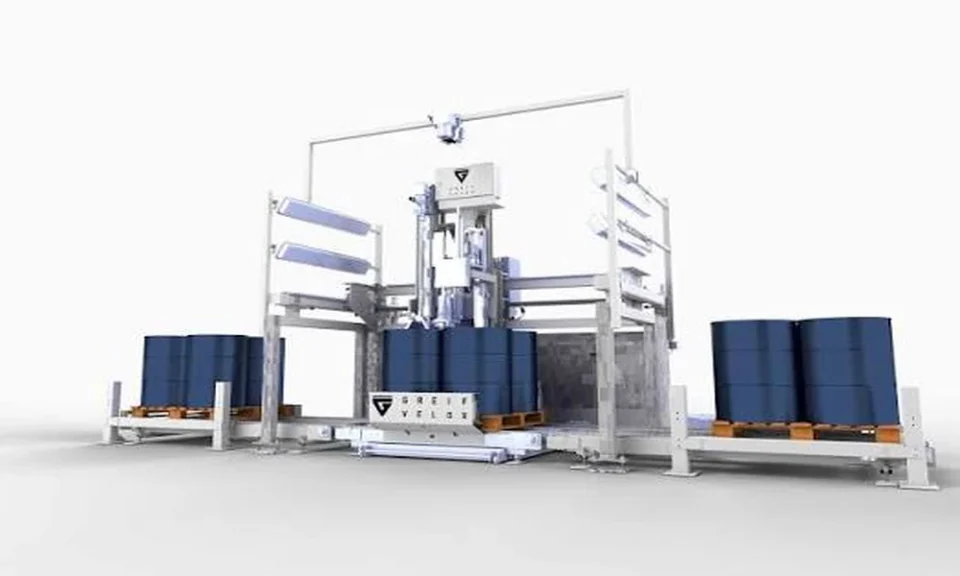
The last station on a production line is usually the one nobody optimised. Product has been filled accurately, sealed properly and labelled correctly, and then a person stacks it onto a pallet by hand at whatever rate they can sustain. Pallet filling systems address that final step, and in most bulk operations they deliver more measurable benefit than an upstream improvement of equivalent cost.
Consistent Output Rate
The defining characteristic of manual palletising is that it decays. The rate achieved in the first hour of a shift is not the rate achieved in the seventh, and the difference is substantial with heavy containers. An automatic system runs at the same cadence from start to finish, which means the line’s output becomes predictable and schedulable rather than something estimated from an optimistic figure and then missed. For planning, that predictability is worth as much as the raw speed.
Manual Handling Risk Removed
Lifting twenty-litre pails, filled cans or heavy cartons from conveyor height to the upper layers of a pallet, hundreds of times a shift, is exactly the movement pattern that produces cumulative back injuries. The cost appears as absence, as claims, and as experienced staff leaving physically demanding roles. Workplace safety obligations here place responsibility for a safe system of work on the occupier, and removing repetitive heavy lifting is one of the clearer ways of discharging that.
Load Quality and Damage in Transit
A machine-built pallet is square, uniformly stacked and consistently patterned. A hand-built one drifts, leans and varies between operators. Uniform loads shift less in transport, stretch-wrap more effectively, stack more safely in a warehouse and produce fewer damaged goods on arrival. Damage claims are typically attributed to transport rather than to how the pallet was assembled, which is why this benefit is real and consistently under-recognised.
Pattern Design Is Where the Value Sits
Interlocking layers, where each course is rotated relative to the one below, bind a load together without wrapping and resist shifting well. Column stacking, where containers sit directly on top of one another, carries compression load better for containers with strong corners. The correct pattern depends on container geometry, top-load strength, pallet dimensions and whether the load is wrapped. A supplier who models patterns against your actual container rather than applying a default is doing the part of the job that matters.
Layer Systems and Robotic Cells
Layer-forming systems assemble a full course on a plate and transfer it in one movement, which is fast and suits high volumes of a single format. Robotic cells place containers individually or in small groups using an articulated arm, which is slower per unit but handles many formats and patterns with only a program change. Operations with several products and frequent changeovers usually favour the robotic route; single-product high-volume lines favour layer forming. Suppliers of automatic palletising systems will size this against your real product mix.
Space, Access and Building Constraints
Palletising equipment needs floor area, headroom and guarded clearance around the working envelope, all of which are scarce in local industrial premises. Measure the clear height under the lowest obstruction rather than to the roof, and check the route into the building including goods lift dimensions and shutter openings. Confirm the slab can carry the point loads involved. Establishing these before ordering avoids the situation where a correctly specified machine cannot physically be installed where it is needed.
Feeding and Discharge Determine Real Throughput
The palletiser depends on both neighbours. Containers must arrive singulated, upright and correctly oriented, so upstream conveyors and orienting devices are part of the specification. Finished pallets must be removed promptly, either by an operator on a schedule or by a discharge conveyor with accumulation for several pallets. Undersizing the discharge is a common and self-defeating economy, since a palletiser that stops because there is nowhere to place a completed pallet has automated nothing.
Wrapping and Load Securing
A palletiser builds the stack; something still has to hold it together. Stretch wrapping is the usual answer, and it is worth automating at the same time rather than later, since a manual wrapper walking round a pallet is slow, inconsistent in film tension, and the point at which an otherwise automated line reverts to a person. Automatic wrappers apply consistent tension and overlap, which uses less film per pallet while holding the load more securely. Where loads are shipped in containers or stored several pallets high, consistent wrapping is what stops a stack leaning by the time it arrives.
Changeover and Product Variety
Ask how a change of container or stack pattern is performed and how long it takes. Recipe-driven systems switch in minutes; systems requiring mechanical adjustment take much longer. For a plant running several SKUs in short batches this frequently determines weekly output more than nominal rate does, and it is the specification most often overlooked when comparing machines on a speed figure alone.
Making the Investment Case
Quantify what palletising costs today, labour hours, the difference between early-shift and late-shift rates, product damage and rework attributable to poor stacking, and any absence linked to manual handling. Model the same figures with the system in place, including installation, commissioning, training and disrupted production during changeover. In most bulk operations, pallet filling automation pays back on labour and injury reduction alone, with the improvement in load quality arriving as an additional benefit nobody costed.
